17.11.2026
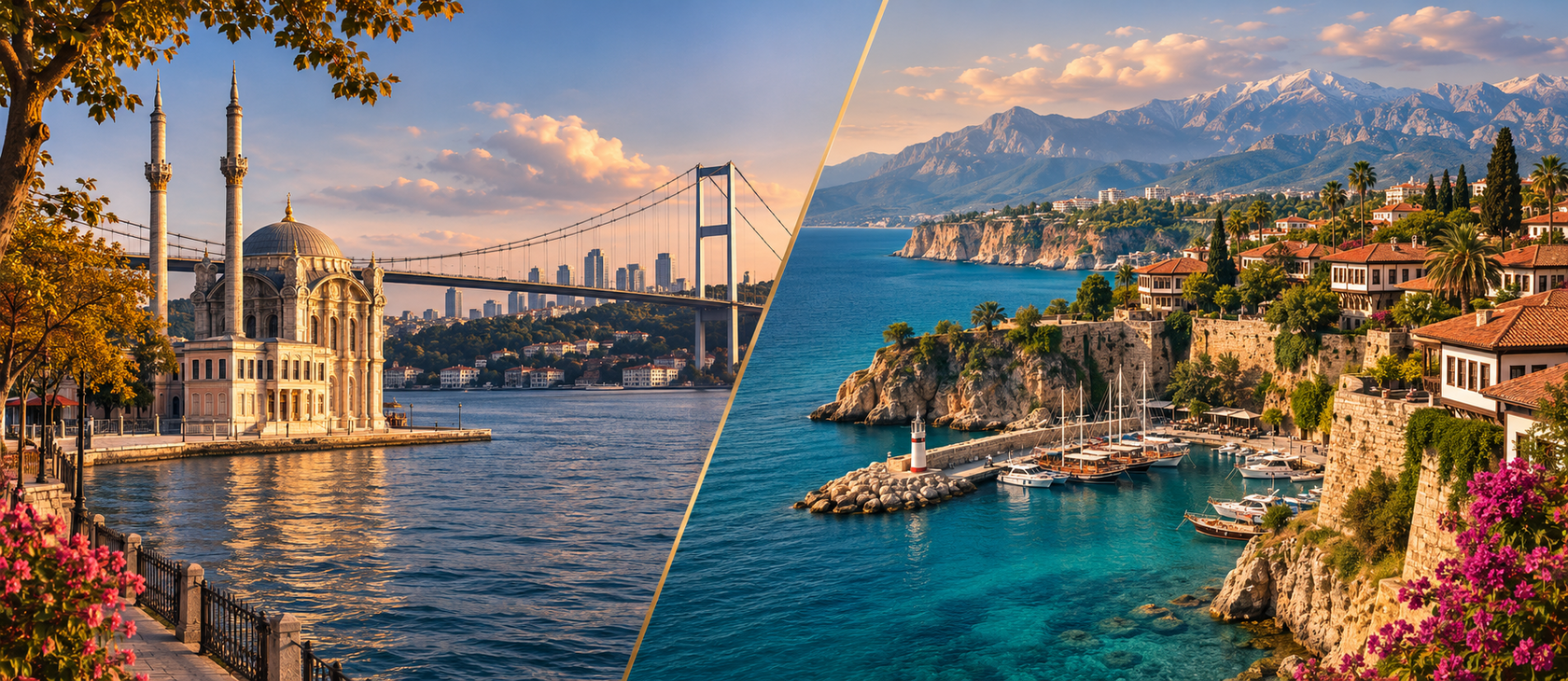
Istanbul or Antalya: where to buy property in 2026
In this article
Five key factsCompare your goalsAntalya: pros and consIstanbul: pros and consFigures and districtsUrban renewalMy conclusionFAQIstanbul or Antalya? I am asked this question more than any other. My answer is that there is no universally right city — there is a right choice for your goal. I have lived and worked in Turkey since 2020 and have worked in real estate and property law since 2007. I divide my life between two cities: the seafront in Konyaaltı, Antalya, and Sarıyer in Istanbul. I invest in both too, with apartments in Maltepe and Muratpaşa. Here I compare the two cities from the inside to help you choose for your own goals.
In brief: Istanbul and Antalya in five facts
- Both rank among the world's ten most visited cities: in 2025 Istanbul was fifth and Antalya eighth.
- Over the year, prices in US dollars increased by 7.3% in Istanbul and 4.7% in Antalya.
- Istanbul has more properties suitable for citizenship applications and faster rent growth: 35.5% in lira over the year.
- Antalya faces an acute shortage of new homes and building land: the seafront and prime locations are already occupied.
- From an investment perspective, the cities are broadly on a par. Your goals and preferred pace of life decide the choice.
Which city should you choose: Istanbul or Antalya?
Each city has strengths and limitations. I therefore start a conversation with a client by asking what they want from their purchase, rather than which city they prefer. Here is how the cities compare for different goals.
| Your goal | Istanbul | Antalya |
|---|---|---|
| Citizenship | Stronger: most properties are suitable | Possible, but fewer suitable properties |
| Rental income | Year-round long-term demand; leading rent growth | Strong rentals in the city centre and by the sea |
| Capital growth | Consistent growth; a leading Turkish market | Shortage of new homes and land offers potential |
| Lifestyle and pace | Fast pace, events and business | Slower pace, sea, mountains and nature |
| Holidays | Urban and cultural | The sea in summer, skiing in winter |
| Business and flights | International hub with direct flights worldwide | Major airport, business and industry |
The author's assessment, based on personal experience and company transactions.
Antalya: strengths and limitations
Antalya is much more than a resort. Around 1.5 million people live in its urban districts, while the province has over 2.7 million residents. Tourism is only part of its economy: business, industry and strong agriculture also support the city. That is one of its principal strengths.
Antalya's strengths
- A global tourism centre. In 2025 Antalya ranked eighth worldwide for international visitors, welcoming 18.6 million people. I expect it to retain a top-ten position in 2026. It is also one of the few cities in that group that is both a major urban centre and a seaside resort. For me, it is one of the world's leading resort destinations.
- A city of international events. In November 2026 Antalya hosts the UN climate summit COP31. According to the Turkish government, around a hundred world leaders gathered for the summit.
- A shortage of new homes. This is very noticeable. There is very little development land, the seafront is fully occupied and so are the best locations. Developers compete for the remaining liquid sites. Even we can count on our fingers the new projects we currently offer clients. In my assessment, once the policy rate falls and mortgages become more affordable, this shortage could drive substantial price growth.
- The sea and mountains nearby. The Mediterranean attracts millions of people every year, while ski slopes and spectacular natural scenery are a two- to three-hour drive away.
- A large Russian-speaking community makes relocating and settling in easier.
Antalya's limitations
- Fewer properties qualify for citizenship than in Istanbul. Cadastral values are often below market prices, and not every property meets the threshold.
- There are fewer large, reliable developers, and the construction process is less transparent. Particularly careful developer checks are essential.
- Life moves more slowly, with fewer public events than in Istanbul. For some people this is an advantage; for others, a drawback.
Buyers most often choose Antalya for rental income, holidays and life by the sea. Citizenship is also a goal, but requires a more targeted selection. It suits people who prefer a quieter seaside lifestyle.
Sources: Euromonitor 2025 Top 100 City Destinations via Habertürk; Sabah on COP31 in Antalya.
Istanbul: strengths and limitations
Istanbul is one of the world's largest cities. Its official population is around 16 million, with unofficial estimates considerably higher. Following recent international developments, I believe Istanbul has become the principal international hub between Europe and Asia.
Istanbul's strengths
- Megaprojects. The Marmaray tunnel beneath the Bosphorus, one of the world's largest airports and the proposed Istanbul Canal, which would effectively turn the European part of the city into an island, represent infrastructure investment worth billions.
- A magnet for global business. Turkey's major businesses are concentrated here. Dubai developer Emaar built Emaar Square in Istanbul, and the city is home to Trump Towers. International entrepreneurs are drawn to it.
- Excellent flight connections. Turkish Airlines flies to 132 countries and 356 destinations. It serves more countries than any other airline, a distinction recognised by Guinness World Records. Most European and Asian destinations are a flight of 1.5–4 hours from Istanbul.
- A global tourism centre. In 2025 Istanbul ranked fifth in the world for international visitors, welcoming 19.7 million people.
- Citizenship. In Istanbul, cadastral values more often match market prices, so most properties are suitable for citizenship applications.
- A leader in price and rent growth. Rents for new tenants increased by 35.5% in lira over the year, or around 14.7% in US dollars. Local demand is exceptionally strong.
- Variety. Modern districts and areas such as Sarıyer, Ataşehir and Nişantaşı sit alongside Belgrad Forest, waterfront promenades, the Sea of Marmara, the Princes' Islands and the unique atmosphere of the Bosphorus.
Istanbul's limitations
- Istanbul cannot be treated as one uniform market. It has 39 districts, and neighbourhoods within the same district can feel like different cities. There are areas where I would not recommend buying under any circumstances.
- Traffic congestion and a very fast pace of life.
- Istanbul is not a resort: if you want a beach holiday, it offers a different experience.
- Seismic risk. I covered this in detail in my article on earthquakes: the key is to choose a building constructed to modern standards on suitable ground.
Istanbul is primarily chosen for investment, citizenship and business. It suits people who want to be at the centre of business, sport and culture, with frequent international travel.
Sources: Euromonitor 2025 via Habertürk; Daily Sabah on Turkish Airlines' 2025 results; Guinness World Records; Central Bank of Turkey rental data, September 2026.
Istanbul and Antalya in numbers
From an investment perspective, the cities are broadly on a par. Below are figures for the past year alongside my own properties.
| Indicator | Istanbul | Antalya |
|---|---|---|
| 12-month price growth, TRY | +26.8% | +23.7% |
| 12-month price growth, USD | +7.3% | +4.7% |
| International visitors, 2025 | 19.7m (5th worldwide) | 18.6m (8th worldwide) |
| My investment property | Maltepe, US$229,000 | Muratpaşa, €220,000 (about US$244,000) |
| Monthly rent | US$1,200 | From US$1,500 (completion in December 2026) |
| Yield before tax | 6.3% | 7.4% |
Sources: Central Bank of Turkey (Istanbul), Endeksa (Antalya), Central Bank USD/TRY exchange rates on 16 October 2025 and 16 October 2026; Euromonitor 2025; the author's contracts. The detailed calculation including taxes is in my article on rental income.
Which districts are growing fastest?
| District | City | 12-month growth, USD |
|---|---|---|
| Üsküdar | Istanbul | +19.8% |
| Küçükçekmece | Istanbul | +18.8% |
| Pendik | Istanbul | +18.6% |
| Bakırköy | Istanbul | +16.1% |
| Ataşehir | Istanbul | +15.6% |
| Muratpaşa | Antalya | +12.3% |
| Kepez | Antalya | +11.5% |
| Döşemealtı | Antalya | +10.4% |
| Manavgat | Antalya | +9.2% |
| Konyaaltı | Antalya | +7.8% |
Source: Endeksa, October 2026, converted into US dollars at the Central Bank of Turkey exchange rate.
Urban districts with strong local demand are growing. That is why I bought my investment apartments in Maltepe and in Muratpaşa, a five-minute walk from the old town. I live where it suits me: in Sarıyer, three minutes from the office, and by the sea in Konyaaltı.
Urban renewal: a smart way to invest in both cities
Both Istanbul and Antalya have very little land left in good locations. More new homes are therefore being built through urban renewal: older buildings are demolished and replaced by modern homes built to new earthquake standards.
For investors, this can be an attractive option. These projects generally occupy excellent locations: central neighbourhoods, established infrastructure and active local demand. Some transactions may qualify for relief from the title deed tax, normally 4%. Eligibility depends on the particular project and the buyer's status, so our lawyer checks it before the transaction. The result can combine a strong location with an attractive purchase. I discuss urban renewal in a separate article.
Source: Law No. 6306 on the transformation of areas at risk of natural disasters; analysis of tax relief at hukukcularevi.com.
My conclusion
Istanbul and Antalya are very different cities, but from an investment perspective they are broadly on a par. Both offer strong demand, liquidity and capital growth. Your goal is what matters.
If you want to combine investment with holidays and life by the sea, choose Antalya. Its Mediterranean coastline and acute shortage of new construction support price growth.
If citizenship, business, a fast pace and being at the centre of events matter most, choose Istanbul. It has significantly more properties suitable for citizenship applications, while rents are rising faster than elsewhere in the country.
If your capital allows it, do what I did: buy one property in each city. Two markets and two types of demand provide the diversification central to a Swiss-style approach to preserving capital. In either city, choose liquid properties: in my experience they account for only around 7% of the available stock.
Frequently asked questions
Where is it better to buy property in Turkey: Istanbul or Antalya?
It depends on your goal. Istanbul suits citizenship, business and year-round rentals. Antalya suits life and holidays by the sea, rental income and growth supported by a shortage of new homes.
Where are prices growing faster?
Over the past year, prices in US dollars rose by 7.3% in Istanbul and 4.7% in Antalya. Differences between districts are even greater: Muratpaşa grew by 12.3% and Üsküdar by 19.8%.
Where is it easier to buy property for citizenship?
Istanbul. Cadastral values more often match market values, and there are significantly more suitable properties. It is also possible in Antalya, but the selection is narrower.
Where are rental yields higher?
For my own properties, the figures are close: 6.3% in Maltepe and around 7.4% in Muratpaşa before tax. However, rents in Istanbul are growing faster than elsewhere in the country.
Why does Antalya have a shortage of new homes?
Very little development land remains, the seafront and prime locations are occupied, construction has become more expensive and fewer new projects are launching.
Can I buy in both cities?
Yes. In my view, it is the best strategy if your budget allows it. Two properties with a combined value of at least US$400,000 may be used together for a citizenship application, as in my case.
How DDA Real Estate Turkey helps
DDA Real Estate Turkey has offices in both Istanbul and Antalya, and I personally live and invest in both. We help you choose for your goals rather than push one city. We show liquid neighbourhoods and properties, assess them against ten liquidity metrics, and select properties for citizenship and urban renewal projects. After purchase, we handle full property management and letting. Contact us at ddakey.com and we will help you select a city, neighbourhood and property for your needs.
About the author
Sergei Dubinets is the founder and head of DDA Real Estate Turkey, a licensed broker, entrepreneur, investor and economist. He has lived and worked in Turkey since 2020 and has worked in real estate and property law since 2007. He invests in Turkish property himself and divides his life between Antalya and Istanbul. ddakey.com
Sources
- Euromonitor International, 2025 Top 100 City Destinations, via Habertürk — haberturk.com
- Sabah: COP31 in Antalya — sabah.com.tr
- Daily Sabah: Turkish Airlines' 2025 results — dailysabah.com
- Central Bank of Turkey (TCMB): house price index and rental index for new tenants, September 2026
- Endeksa: prices by district in Istanbul and Antalya, October 2026
- Law No. 6306 and urban renewal tax relief — hukukcularevi.com
- The author's contracts and personal experience
This article is for information only and does not constitute individual investment advice.